

ChinaTravelNews, Ritesh Gupta – Hotel chain H World Group is accelerating its portfolio transformation by pushing deeper into upper-midscale tiers and systematically upgrading its economy and midscale flagships.
At the heart of this expansion are the group’s limited-service “Golden Triangle" brands: HanTing, JI Hotel, and Orange. Chief Executive Officer Jin Hui noted that management has designated these three as the primary growth engines for the network.
As of June-end, HanTing Hotel anchors the entire network, boasting 4,710 operating hotels (over 408,000 rooms) and an additional 975 unopened properties in the pipeline, dwarfing any other single brand in the portfolio.
To drive sustained performance, the company is systematically rolling out modernised iterations across its portfolio.
This continuous product upgrade has allowed the newer-version hotels to deliver meaningful improvements in RevPAR.
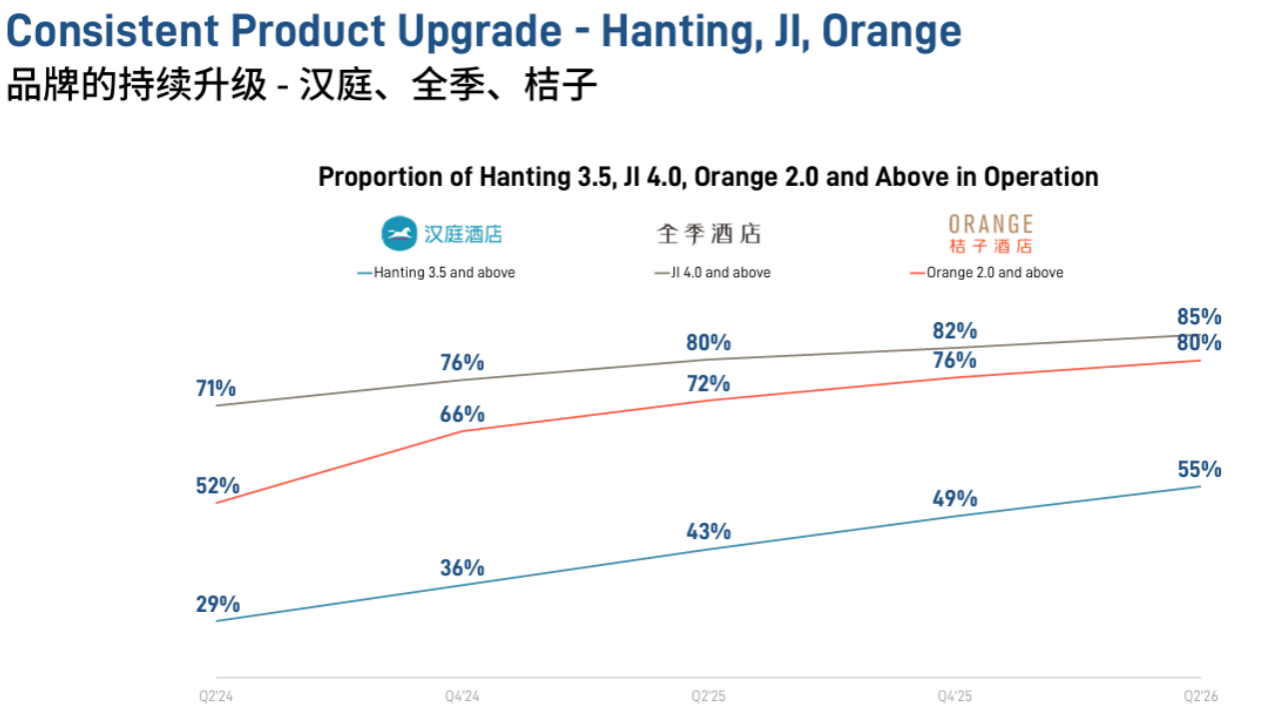
The transition is particularly evident in the growing proportion of modernised properties in operation: HanTing (3.5 and above): climbed from 29% in Q2 2024 to 55% in Q2 this year; JI Hotel (4.0 and above): rose from 71% in Q2 2024 to 80% in Q2; Orange Hotel (2.0 and above): grew from 52% in Q2 2024 to 85% in Q2. However, looking at mature properties open for more than 18 months, same-hotel operational data reveals a more nuanced picture; same-hotel RevPAR dipped 3.0% year-over-year to RMB 233, reflecting softer occupancy rates across older cohorts even as brand-new iterations pull up the portfolio average.
Despite economy hotels holding a larger count of operating properties (6,245 versus 5,779), the midscale segment commands a significantly larger room inventory (622,012 rooms compared to 513,260 for economy), reflecting a higher average room count per hotel driven by heavyweights like JI Hotel.
Simultaneously, H World is pushing aggressively into the upper-midscale segment, which has maintained unbroken quarter-over-quarter expansion, rising from 1,289 hotels in Q3 of 2024 to 1,632 by year-end 2025, before reaching 1,738 hotels in Q2 2026 (a 13.4% year-over-year increase across active operations and the pipeline).
This higher-tier push is anchored by four key flagship brands: IntercityHotel, Grand JI, Crystal Orange Hotel, and Mercure, allowing the company to capture dual-vector demand from native consumption upgrades as well as travelers shifting away from traditional upscale properties. This allows H World to tap into evolving consumer preferences where travelers increasingly seek premium experiences without paying legacy upscale price tags.
Rather than chasing pure top-line volume, it is evident that H World’s growth is anchored in a quality-driven brand evolution. Jin shared that the initiatives have resulted in meaningful RevPAR improvements. Powering this entire transformation is the group’s asset-light business model, encompassing franchised properties and managed-and-franchised (M&F) contracts. H World’s hotels are operated under three different models: leased and owned, franchised, and franchised hotels that the team operates under management contracts (manachised). M&F revenue rose by 24.2% year-over-year to RMB 3.6 billion and gross operating profit grew by 18.5% to RMB 2.2 billion in Q2 2026, fueling overall adjusted EBITDA margins of 38.3%.
Alongside this quality-driven evolution, the hotel network kept expanding at a solid pace, with 498 newly-opened hotels across China during Q2, while the number of hotels in the pipeline grew both year-over-year and quarter-over-quarter. Jin noted that management remains firmly on track to hit the full year gross opening guidance of 2,200 2,300 hotels.
Brands like Madison Hotel (125 in pipeline vs. 228 in operation) and IntercityHotel (113 in pipeline vs. 191 in operation) exhibit massive relative pipeline growth, signaling rapid upcoming footprint scaling.
For the broader hospitality industry, H World’s trajectory signals a shift from unrestrained room-count growth to asset-light upgrading. As mature property yields face normalisation pressures, the industry can expect upper-midscale tiers and continuous product iteration to become the primary battlegrounds for capturing value-conscious consumers trading up from the economy segment.