
This summer, a football fan flying to Los Angeles for the World Cup may appear to have a simple itinerary: a match ticket, a few nights’accommodation, and perhaps a side trip to Las Vegas.
But the truly complicated part of the journey only begins the moment the plane lands. How do you get from the airport to where you are staying? If check-in isn't until the afternoon, where would you stash your luggage? If you are booking a place with a kitchen, how do you handle your first meal? On those two or three days outside the competition, where do you go to avoid feeling like just a tourist? And if you're traveling with your family or friends, how do you align everyone's plans, interests, and budgets?
In the past, solutions to these questions were scattered across different apps. You can book hotels on online travel agencies, order rides on mobility platforms, look up travel tips and places to visit on content platforms, find restaurants through review sites, and turn to AI for last-minute planning. Today, travelers are getting more information at a faster pace than ever —but what they truly seek is not an ever-expanding list of options. What they need is someone to help them decide: which choice deserves their trust.
When AI becomes part of the decision-making process, every platform faces a new challenge: when answers are no longer scarce, who can make users believe that one particular answer is actually worth your trust?
This is the new story that Airbnb wanted to tell at the 2026 Summer Release.
On the surface, Airbnb expanded to an entire set of new products and services: Boutique and Independent Hotels, Grocery Delivery, Airport Pickups, Luggage Storage, Car Rentals, exclusive FIFA World Cup 2026™ Experiences, a smarter Trips tab, and more social travel recommendations.
So people not knowing Airbnb well keep asking the same familiar question: Is Airbnb increasingly becoming an OTA ?
This perspective certainly has its basis. In fact, competition for the “entry point” of booking a trip has long expanded beyond traditional OTAs to a much broader range of online platforms. In April this year, Uber announced a partnership with Expedia, enabling users in the United States to book hotels directly within the Uber app, with accommodation inventory expected to expand to more than 700,000 worldwide. At the same time, Uber also launched Travel Mode, integrating local recommendations, OpenTable restaurant reservations (a brand under Booking Holdings), and hotel doorstep delivery services.
Travel is increasingly being redefined and fragmented by a growing number of platforms, but each player is approaching it differently: OTAs enter through transactions, Uber through mobility and local on-demand services, and AI tools start with itinerary planning and information assistance. What sets Airbnb apart is that it started with the sense of belonging at a Home — and extends the trust users place in the destination far beyond the accommodation itself.
This is actually a far more interesting question than "is Airbnb becoming an OTA?"
Because what Airbnb needs to prove is not just that it looks different from an OTA. More importantly, after it enters more and more scenarios that OTAs might already cover, it must show users why they should still trust the choices Airbnb provides.
According to Nathan Blecharczyk, Airbnb's co-founder and Chief Strategy Officer, the company's expansion into new sectors is driven not simply by increasing transactions or improving convenience, but by a desire to apply Airbnb's distinctive vision of travel across additional verticals. In his view, traditional OTAs are more focused on price comparison and fast conversion, whereas Airbnb wants travelers to feel “more like insiders, rather than outsiders.”.
This signals a fundamental shift: Airbnb is repositioning itself from a "supply marketplace" to a "curation engine".

Traditional OTAs operate on a simple logic: give users as many choices as possible, leaving them to sort it out by price, rating, and location on their own. Airbnb is betting on something different — curating the options first, then surfacing the stays, experiences, and services that are aligned with its vision of travel. Whether that's the right call is open to debate, but it has undeniably shaped Airbnb’s long-standing consumer perception: maybe it’s not the cheapest, but often the most unique; not the most standardized, but perhaps closer to the authenticity of the destination itself.
And this is precisely what makes Airbnb's recent push into boutique and independent hotels such a delicate move.
Viewed simply as category expansion, Airbnb's expansion into hotels looks almost like it's catching up on the OTA playbook. However, Airbnb clearly doesn't want to become another hotel marketplace. In an interview with TravelDaily, Nate said Airbnb won't list every hotel out there — large chains like Marriott or IHG are notably absent — and will instead focus on properties across different price tiers that offer a stronger experiential edge. After check-in, features like Travel Map, Host Recommendations, and AI-Selected Reviews are meant to help guests understand the neighborhood and what's worth doing nearby.
In other words, by bringing hotels onto the platform, Airbnb is extending its curation power beyond homestay service.
Brian Chesky, Airbnb's co-founder and CEO, made much the same case from a business perspective. Independent hotels, he argued, are anything but niche — they account for around 59% of the global hotel market — and Airbnb's ambition is to make them easier to find, without turning them into yet another row of standardized commodity listings..
More importantly, Brian Chesky also shared a revealing data point from Airbnb: among users who book hotels on the platform, 55% later return to book a home. Hotels, in other words, aren't positioned as a replacement for Airbnb's listings — they're a new pathway into the Airbnb ecosystem – a word that was especially notable throughout this year’s launch event.
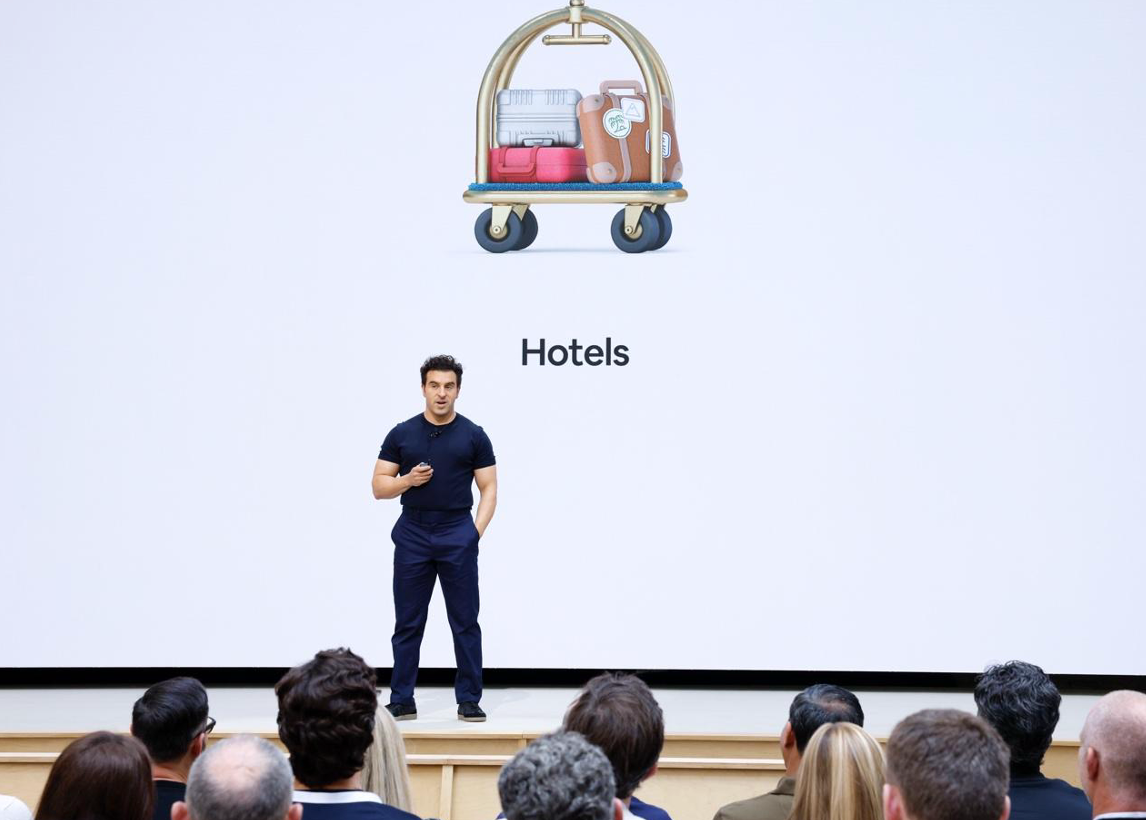
For years, Airbnb has defined itself through the word community, emphasizing the connection between hosts and guests and the sense of belonging that non-standard accommodations create. But at this year's Summer Release event, ecosystem began to take its place as the word used to frame Airbnb's expanding business mix.
This shift in vocabulary carries a subtle signal: A super app is about having everything; an ecosystem is about connecting everything.
What Airbnb now strives to prove is not whether a single new business can grow into the second growth driver, but whether hotels, experiences, services, Homes, Connections and Trips Tab can form a multi-entry point growth flywheel.
Users may join the platform for FIFA World Cup experiences and book a stay next time. They may access the platform to reserve boutique hotels, then pay for local experiences and services later. Those who merely open the Trips tab can be inspired by their friends’ previous trips.
This is also why the FIFA World Cup is such a valuable lens for observation..
This top-tier global sport event naturally features group trips, longer stays, multi-city itineraries, local experience demands and new user acquisition. According to data from Airbnb China, in the first few months of 2026, bookings for stays in FIFA World Cup host cities by Chinese travelers surged by 200% year-over-year. And globally, group travels accounted for over half of all FIFA World Cup-related bookings. Among international visitors traveling to the USA, 70% extended their trips to explore local experiences after watching the games.
For Airbnb, major sport events are far more than just marketing opportunities, but high-intensity operational stress tests. Users are not only looking for a place to stay for a night, but also need to solve a chain of needs on the ground — transportation, luggage handling, dining, local experiences, coordination with companions, and planning the next stop. The exclusive FIFA World Cup experiences, airport pickups, luggage storage, car rental and the new Trips Tab launched by Airbnb precisely cater to these practical demands.
But what ultimately supports the viability of this entire approach is not just how many new features are added, but also the strength of the app’s entry point and underlying technology infrastructure.
Dave Stephenson, Chief Business Officer of Airbnb, stated to Travel Daily that the company has rebuilt its tech stack over the past few years to support future expansion. Although Services, Experiences and hotel bookings currently contribute a relatively small share to total revenue, they exert profound influence on overall business development, as they reshape users' perception of Airbnb's service scope.

Airbnb’s latest app upgrades, is in fact the concentrated release of years of technical restructuring. The goal is to transform the app from a tool that users open only once before booking, into a trusted entry point that can be revisited across the entire travel journey — before departure, during the trip, and even after it ends.
In the AI era, the significance of this entry point becomes even more complex.
AI can generate an itinerary within seconds, OTAs can rank prices from low to high, and social platforms can endlessly push out inspirational contents. Yet even with more answers available, travelers may still feel anxious, because they do not know which answer is the right one. Therefore, the better AI can do at producing answers, the more important real brands, peer recommendations, and actual fulfillment become.
Airbnb is also applying AI extensively. According to Brian Chesky, they are using AI to generate personalized listing highlights for different travel needs, summarize reviews, and allow users to ask direct questions about listing details. With a large base of authentic reviews on the platform, Airbnb can use AI to help users more quickly understand whether a listing matches their expectations.
Though AI can help users filter information faster, summarize reviews, and improve matching efficiency, trust itself still has to be supported by the brand, authentic reviews, and the high-standard uphold on the supply side..
Brian Chesky noted that the best travel recommendations often come from people that users already trust, such as friends and family. By incorporating where friends have been, where they have stayed and what they have done into user profiles and travel maps, Airbnb is attempting to shift travel decision-making away from one-off recommendations generated by cold algorithms and back toward trusted relationships and community-based experience.
What behind this is actually a more fundamental question for the next generation of travel platforms: when every platform is capable of making recommendations, who shall users choose to trust?
While the traditional OTAs believe in inventory shelves and price comparison, Uber believes in instant fulfillment, AI believes in production efficiency, Airbnb is betting on brand affinity, authentic reviews, and the relationship between people and places.
Of course, whether this story holds true cannot be proven by values alone.
The broader Airbnb expands its business, the more concrete its challenges become. Whether the airport pickups are punctual, the luggage storage are secure, the grocery deliveries are accurate, the car rental experiences are seamless, the boutique hotels truly meet Airbnb’s standards, and the exclusive FIFA World Cup experiences are worth trying — all these factors determine whether users will trust Airbnb again.
Although Airbnb has emphasized the uniqueness of its supply from the very beginning, Dave also acknowledged that some of the newer services — such as airport pickups and luggage storage — are not necessarily unique in themselves. Their core value lies in making the journey easier. When it comes to whether Airbnb will expand into additional categories such as airline tickets, his guiding principle is equally pragmatic: the key question is whether it helps users make travel planning and execution simpler.
This is arguably the most noteworthy aspect of Airbnb’s next development phase.
It clearly has no intention of being perceived as another OTA, nor does it aim to become an all-in-one super booking app.
What it truly seeks to validate is that amid the advancement of AI and platform expansion, it can still deliver a reliable framework for travel: identifying worthwhile stays, valuable experiences, hassle-free services, and genuine recommendations that help users connect to the destination.
AI can generate countless answers, yet what remains valuable is earning users’ trust to commit to a single choice.
For Airbnb, this is an even larger question than simply whether or not to become an OTA.